From Training Runs to Competition: The Rise of Cross Country at Oregon
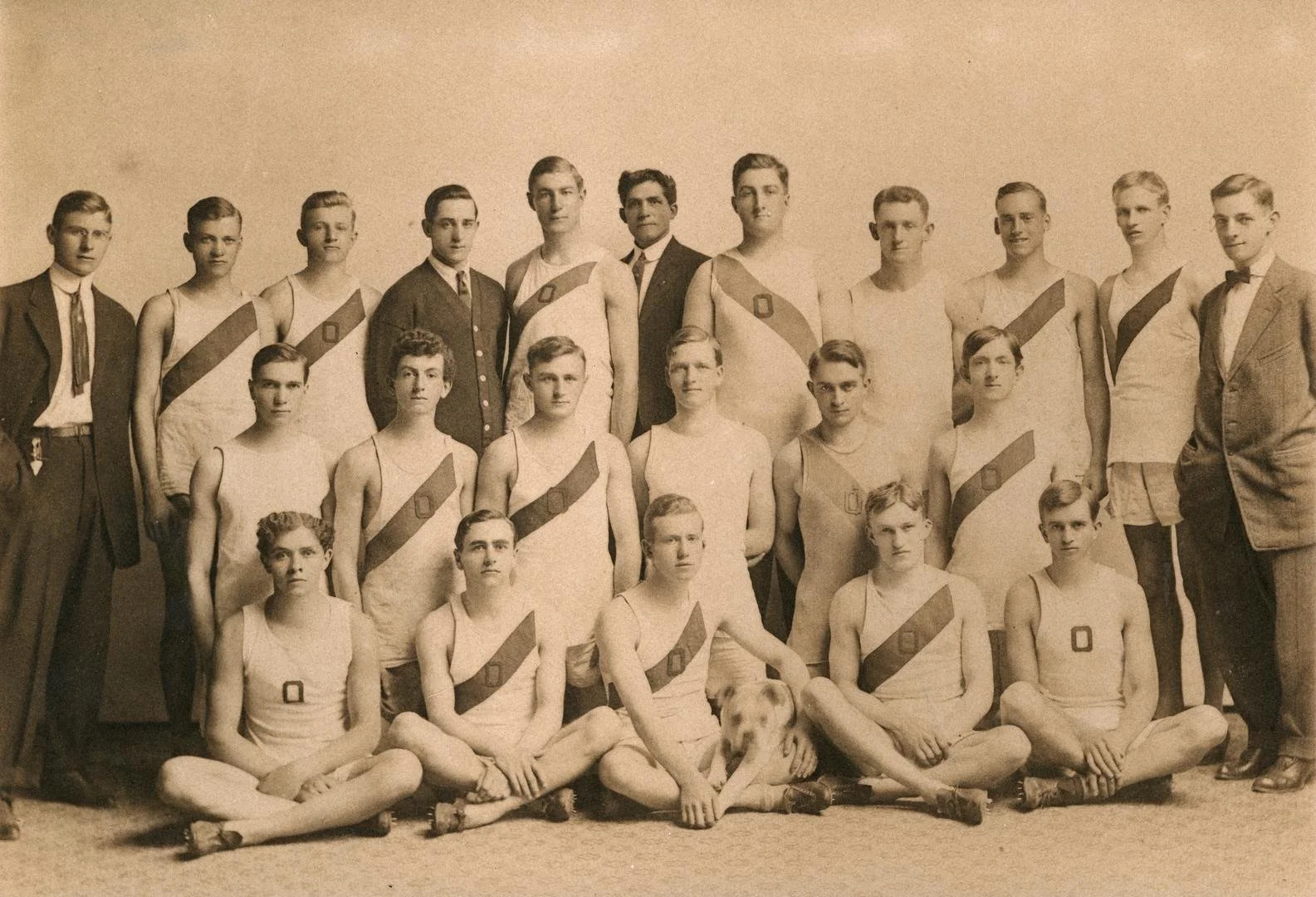
1910 Track and Field Team, including Earl Henry, middle row, far right side.
The development of cross country at the University of Oregon reached its defining moment in February 1910, when Oregon hosted what the Oregon Emerald called the “first intercollegiate cross country run in the Northwest.” The meet represented the culmination of several years of experimentation, training, and organization under track trainer Bill Hayward, transforming cross country from a conditioning exercise into an established competitive sport. Hayward supported “winter training, as he says the poorer man, with the advantage of training all winter, will undoubtedly beat the man who has only the six weeks of spring work the Oregon climate allows” (Eugene Daily Guard).
Oregon’s runners had been using cross-country running as part of their training since at least 1904, when The Oregon Weekly reported that Captain Perkins and several long-distance runners were taking cross-country runs to “develop endurance and wind.” By 1906, Hayward had further incorporated “cross country runs, hare and hound games, and paper chases” (Eugene Daily Guard) into fall and winter training. In 1907, students were competing in class cross-country races over a course of roughly two and a half miles. The course traversed the area south of campus: “one lap on Kincaid field, down 13th to Alder, out Alder to the second cemetery, along the foothills to the streetcar track, down the track to 13th, thence to Kincaid, finishing by running one lap around the track” (The Oregon Weekly). These activities laid the foundation for more formal competition.
The major step came in November 1909, when approximately twenty students organized a cross-country club. According to the Oregon Emerald, Hayward supported the formation of the club and commented that “‘cross-country work,’ says he, ‘has never been as popular as it should be at the University of Oregon, for it is one of the few winter sports that the climate permits.’” The formation of the club quickly became important when Oregon arranged an intercollegiate race with Oregon Agricultural College (O.A.C.). The schools agreed upon a four-mile race, requiring Oregon to extend its existing course by adding additional laps around Kincaid Field.
The Oregon Emerald described the race held on February 22, 1910, as the “first intercollegiate cross country run in the Northwest” and called upon students to attend, noting that “Eugene has a record as the best town in the Northwest for track meets.” The race was run under difficult conditions: two inches of snow had fallen, the resulting thaw left the course muddy and soggy, and parts of the track were especially poor.
Despite the conditions, Oregon produced a remarkable team performance. All five Oregon runners finished ahead of O.A.C.’s five competitors, giving Oregon a 40–15 victory. Freshman Earl Henry won the four-mile race in 19 minutes and 53 seconds. The Eugene Daily Guard questioned whether the course was actually four miles given the remarkably fast time under the less-than-ideal conditions. His performance attracted particular attention because, according to the Morning Oregonian, his shoe came off in a mudhole during the final lap around Kincaid Field. Henry continued running barefoot and actually increased his lead.
The 1910 race therefore marked a turning point: cross country at Oregon had moved beyond a method of winter conditioning and emerged as a distinct intercollegiate sport.