Arthur “Ole” Larson and Hayward Field
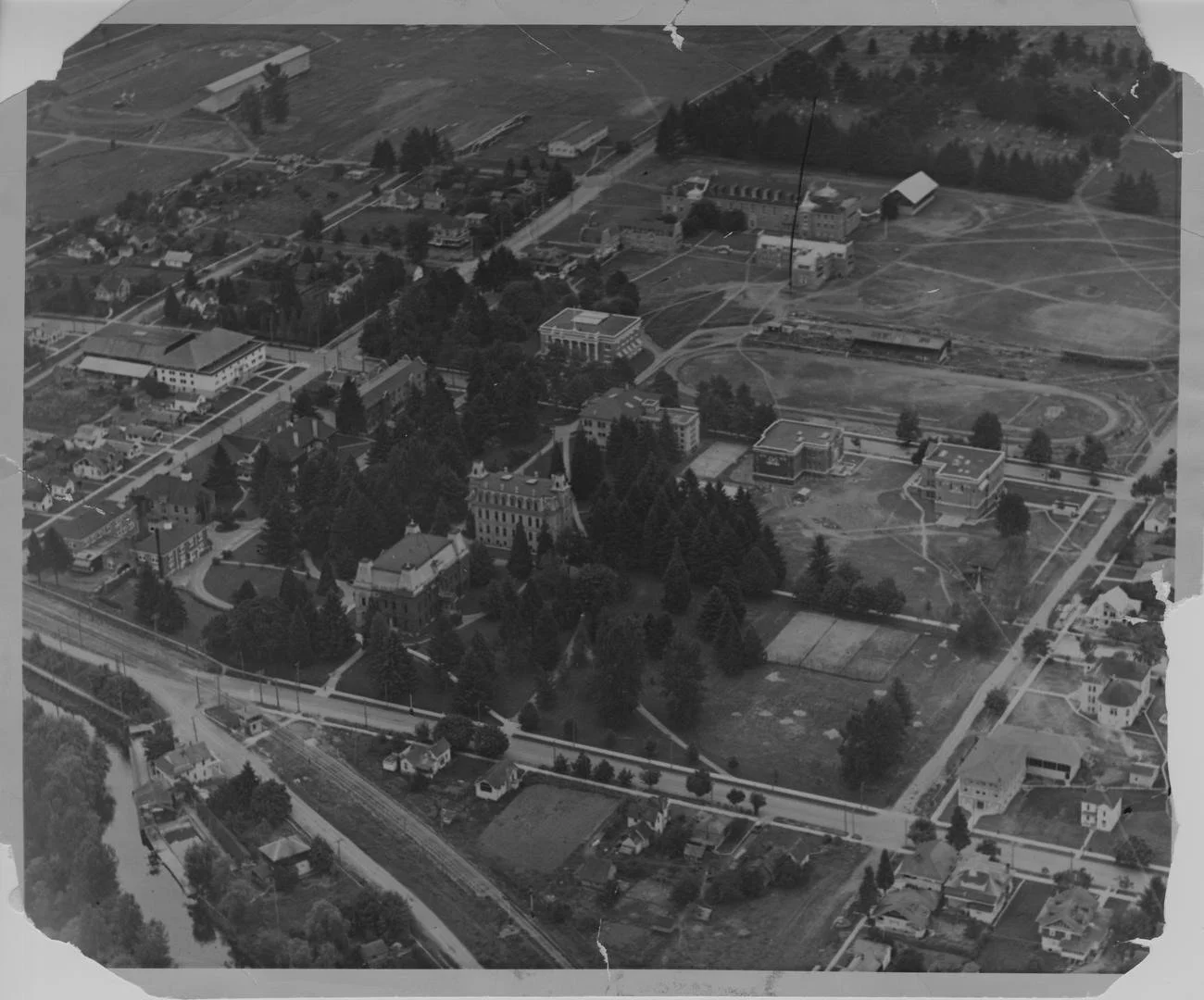
Campus Aerial, 1921: Hayward Field in upper left corner, Kincaid Field in the middle
Arthur J. “Ole” Larson was once described as “one of Oregon’s speediest sprinters” (Old Oregon, November 1923). He also holds a unique distinction: he was among the first athletes to set foot on the new cinder track at Hayward Field in the spring of 1921.
Although Hayward Field was dedicated during a football game on November 15, 1919, nearly two more years were required to complete the track. As Old Oregon reported in April 1921 (p. 5): “The new track around Hayward Field is at present nearly completed. The gravel foundation has been laid and cinders have been ordered for the top layer. When it is completed it will compare favorably with any other track on the coast.” The first meet on the finished track took place May 14, 1921—a dual meet against Oregon Agricultural College (known today as Oregon State University).
Larson was born in 1898 in Michigan to naturalized Swedish immigrants, John and Augusta. After a brief stay in Wisconsin, the family moved to Eugene sometime between 1905 and 1910. His father first worked at a sawmill before beginning a long career as a gardener at the University of Oregon. The family home stood on the site of today’s Living Learning Center, across from Hayward Field.
In November 1917, Larson joined the U.S. Navy and served as a “radio operator on a submarine chaser” (The Oregonian, Feb. 17, 1980). He enrolled at the university in fall 1919 as an ex-serviceman under the Soldiers’ and Sailors’ Act. In a 1973 reflection appearing in the autumn issue of Old Oregon, Larson recalled that he initially intended to try out for a different sport:
“In the fall I decided I might like to try out for freshman basketball, so I put on my gym suit and trotted out to Kincaid Field, which stretched from Johnson Hall to Kincaid St., on the south side of 13th Ave. At this season the oval track was rough, but back of the grandstand was a covered shed about 150 yards long. Under this shed the track men jogged. Bill Hayward saw me and one or two other runners and suggested we run the 100 with Hank Foster. Hank was track captain and his time for the 100 was 10 flat. I made a couple of holes in the clay surface and tried to emulate Hank who slipped into his starting holes like the slick vet that he was. I got out of my hole and tried to follow him down the 100 run. He beat me by about a yard. As I came back, Hayward asked me what sport I was interested in. I mentioned basketball and he shook his head and said for me to report for track. That’s how I started.”
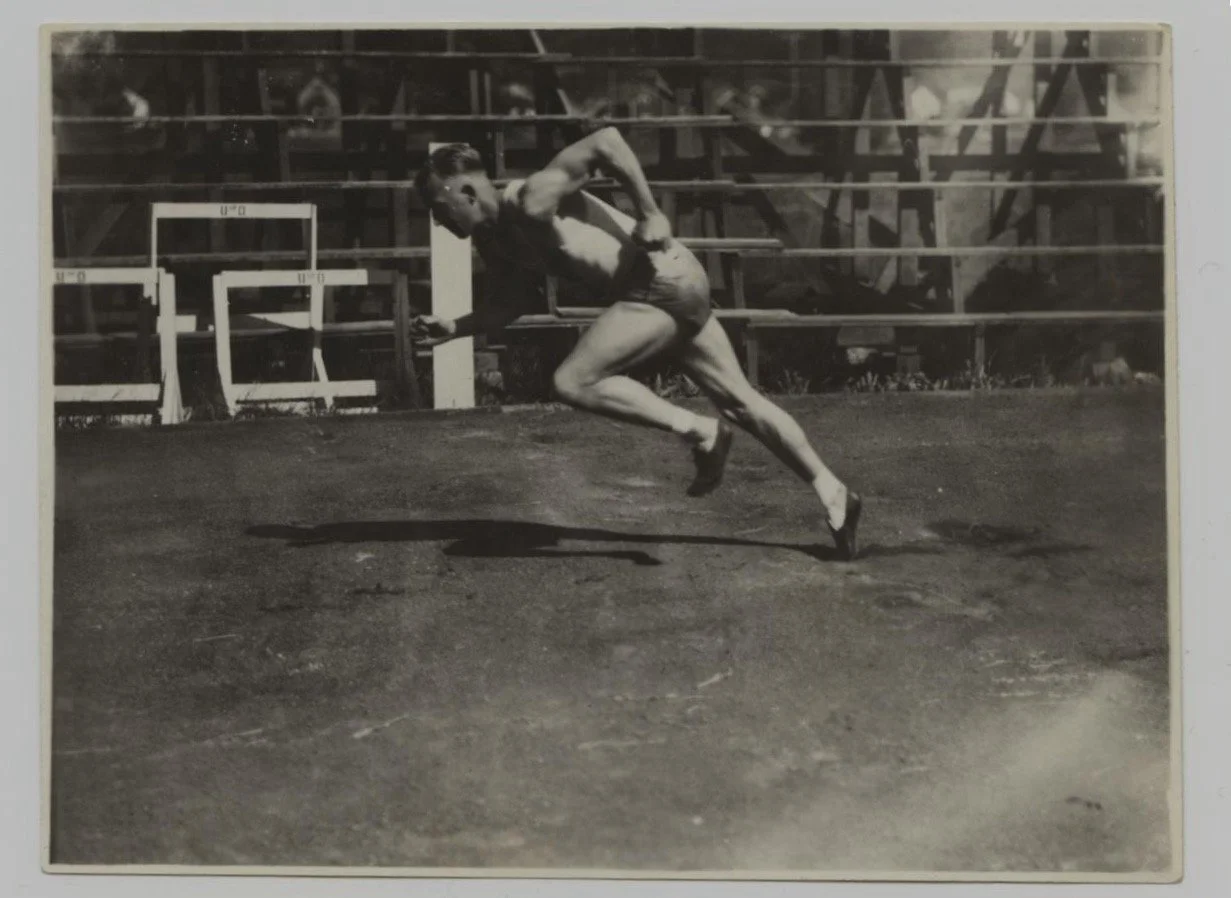
Art Larson, 1922
Hayward’s brief directive changed the course of Larson’s athletic career. Larson quickly distinguished himself in the 100 and 220 yard dashes. He ran the 100 yard dash in 10 seconds multiple times and even defeated Vic Hurley of the University of Washington, one of the region’s top sprinters.
When the cinder oval at Hayward Field was finally ready in 1921—at a reported cost of about $10,000—Larson was present for its inaugural use. He later recalled:
“The first day it was to be used Roscoe Hemenway – later a famous Portland architect – and I were going out of the gym to track practice. Bill Hayward came by in his maroon Marmon roadster, given him by the alumni as a token of his coaching service. Hemenway got in and I stood on the running board. When we got to the track, Bill asked who would be the first track man on the new field. We both had a distinction. I was the first letterman on the now famous track, and Roscoe was the first on in spikes” (Old Oregon, Autumn 1973)
At the end of the 1922 season, Larson’s teammates unanimously elected him as captain of the track team for the following year. In 1923, he graduated with a degree in journalism. He later lived in Portland and worked in “advertising, public relations and freelance newspapers and magazine writing” (The Oregonian, February 17, 1980). Though his professional career was varied, Larson’s legacy remains closely tied to the early history of Hayward Field and the beginnings of what would become one of the most storied venues in American track and field.